
2026 - We're Back !
Published: 21 June 2026
And this time just for fun !
Inspired by a recent visit to the Synth Temple we decided that sounds are just too beautiful to not try and see them. So here we are again, trying to solve the “how do sounds look like ?” and sharing whatever we find.
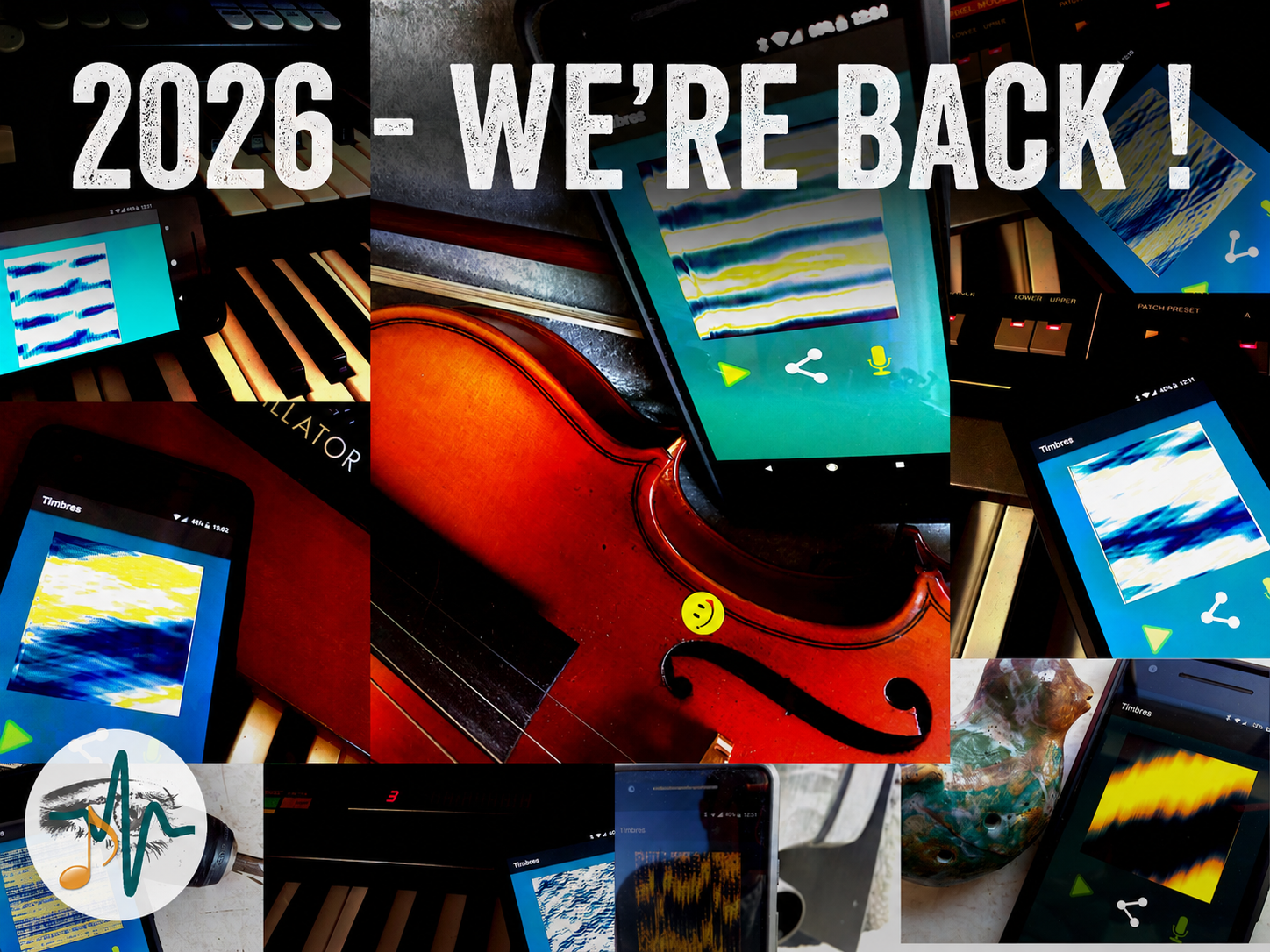
Stay tuned.
Timbres Android App
Published: 16 April 2018
We’re alpha-testing our “Timbres” Android app…
Real-Time Visualisation of Sound Timbres
Published: 20 November 2013
Applied to audio signals, our technology allows to convert sound to image and vice versa. Applied in realtime, this can be used to create an animation of evolving sound timbres:
We believe that sound characteristics such as “sharp”, “smooth”, “warm” or “edgy” can be recognised via some visual counterparts. Do you agree ?
Audio Gallery
Published: 17 March 2011
“See Sound…”
A mathematical transformation converts the timbres of sounds to images. Below is a random collection of sounds with their visualised timbres for illustration.
Do they look like they sound ?
Strings
Organs
How it Works
Published: 16 March 2011
Signal Modeling in the Time-Phase Domain
Signals are traditionally modelled in the time domain or in the time-frequency domain. Our modeling operates in the time-phase domain. Just like existing models this introduces an entirely new class of processing methods and algorithms applicable to signal analysis, modification and synthesis.
Signals are represented as a separation into timbre, pitch, amplitude envelope and phase offset. The timbre is visualised via a 2D coloured image referred to as cyclogram. We define :
- Pitch: the ‘fundamental frequency’, ‘key’ or ’note’ as a function of time
- Cyclogram: the pitch-removed time-waveform, transformed into the time-phase domain.

This representation as a split into timbre and other components is referred to as a “sunic”. The transformation between a signal and its sunic is lossless and reversible. The split allows to compare and classify audio signals based on their natural characteristics (timbre) independent of their fundamental frequency, amplitude envelope or phase offset. The splitting of a sound into its sunic requires high-accuracy pitch detection with resolutions significantly below sample duration.
Measuring Ground Conditions via Sound Timbres
Published: 16 March 2011
One of our most fun experiment so far. We buried shakers and microphones in the ground and built a cloud-based telemetry solution analysing changes in sound timbres. This delivered a reliable and automated monitoring system for turf management. It involved out-of-the box thinking, physics, audio engineering, soldering & cabling, software programming, cloud infrastructure, landscaping equipment and a fabulous team of stakeholders and helpers.
Best of all - it worked !